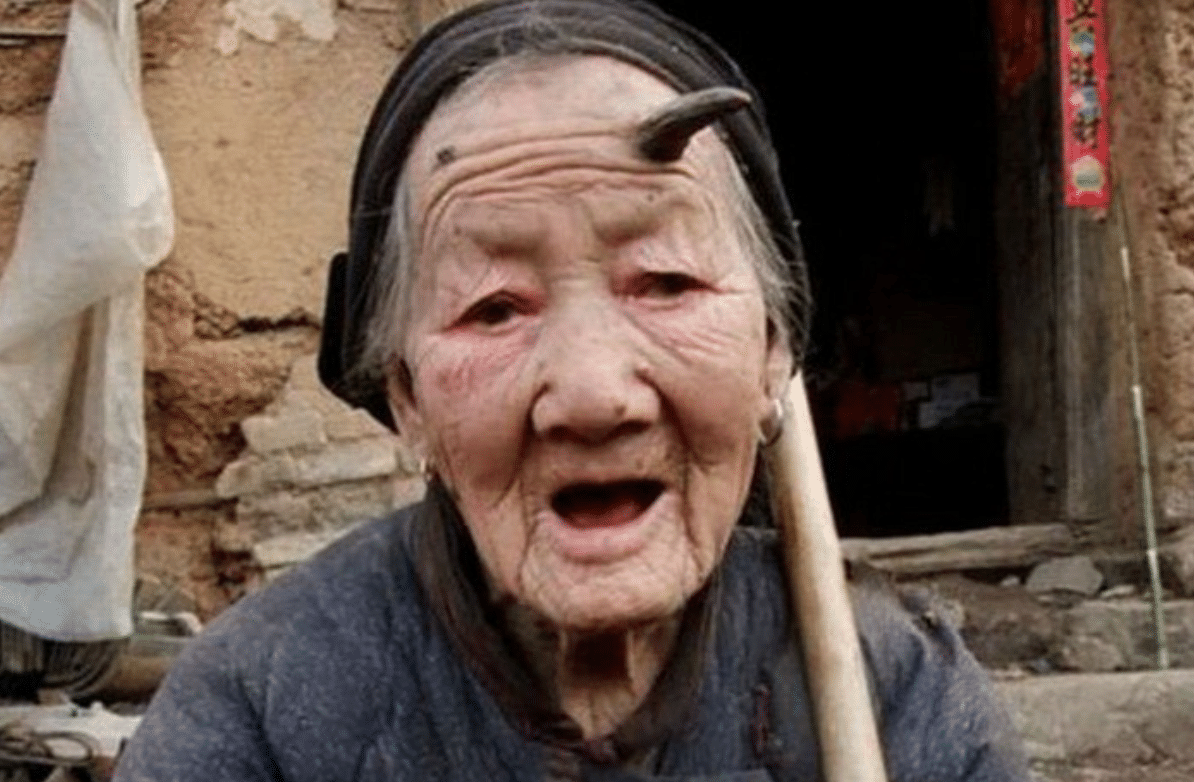
At first, relatives paid little attention to a small, dark spot above the left eye of 101-year-old Zhang Ruifang, from China’s Henan province. It looked like an ordinary patch of rough skin. But a few months later, it became clear that something unusual was happening. The growth gradually enlarged, hardened, and began to curve downward.
Within a year, it had reached about 6 centimeters in length and bore such a striking resemblance to a goat’s horn that the older woman’s story quickly spread far beyond her village.
Neighbors couldn’t believe their eyes.
When fellow villagers learned of Zhang’s unusual feature, curious people began flocking to her home. Some found the strange growth frightening, while others tried to explain it through ancient folklore.
But the woman herself saw nothing alarming.
Despite its dramatic appearance, the growth caused her no pain. Zhang continued her normal routine: walking around the village, chatting with neighbors, and helping her family with household chores.
However, the growth’s appearance was truly striking. Dark, hard, and curved, it almost perfectly mimicked a small horn.
That raised the big question: what exactly was it?
No mystery involved—the cause was far more mundane.
The medical explanation was no less surprising.
Such growths are known as “cutaneous horns.” It is neither a real horn nor a bony outgrowth; instead, it is formed from an accumulation of keratin—the same protein found in human hair and nails. In certain areas of the skin, the body produces and accumulates an excess of this substance. Gradually, layers of keratin harden and form a solid protrusion that resembles an animal’s horn.
These growths are most common in older people and can develop against a backdrop of various skin changes, including those caused by sun exposure. Typically, they are much smaller than the one that appeared on Zhang.
But the story didn’t end there.
Then, a second “horn” was discovered.
As they documented the unusual case, another detail caught the observers’ attention.
A small, dark bump had appeared on the right side of the older woman’s forehead. Notably, it was positioned roughly symmetrically to the first growth—in the exact spot where the first “horn” had begun to form a year earlier.
It appeared that the woman might be developing two such growths simultaneously.
Specialists noted that cutaneous horns can be surgically removed, and the resulting tissue is usually examined to determine the underlying skin condition. However, Zhang’s family initially hesitated to proceed: the woman was not experiencing any discomfort, and the growth itself was painless.
The story of 101-year-old Zhang Ruifang reads like a sci-fi movie. Yet, beneath the startling appearance lies a very real phenomenon of human biology.
 Discuss
More news
Discuss
More news