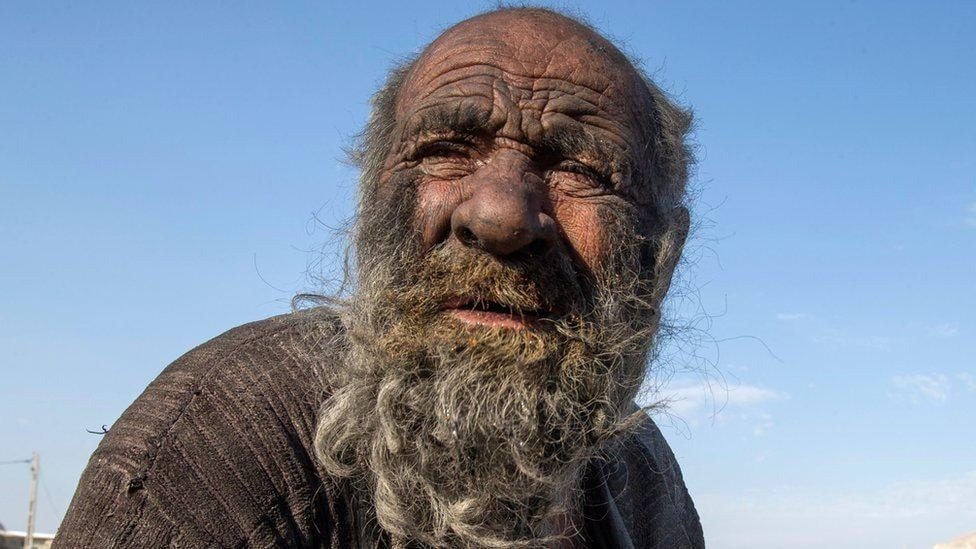
The story of Amou Haji is astounding. While most people can’t imagine life without a daily shower, this man from Iran’s Fars province consciously abstained from bathing for over six decades. He believes that excessive cleanliness can harm the body, while dirt, on the contrary, strengthens the immune system.
He decided to abandon hygiene in his youth after a severe emotional trauma. Since then, he has distanced himself from society and chosen solitude.
The peculiarities of his existence go beyond simply abstaining from water. He eats mostly spoiled food, believing that fresh produce and clean water can weaken the body and provoke illness.
He lives in extremely simple conditions. Sometimes he sleeps in a hole dug in the ground, resembling a small shelter, and other times in a modest brick structure built for him by locals.
Despite this, he himself apparently does not feel unhappy. His lack of possessions frees him from worries about money, debt, and the safety of his belongings.
He does, however, have certain personal care habits. He drinks a significant amount of water daily, storing it in an old metal container. He cuts his hair unusually by burning it.
His life evokes conflicting emotions, ranging from horror to admiration. His story prompts reflection on whether comfort, technology, and constant social activity are truly necessary for happiness.
His existence also raises questions about the limits of human endurance. The body has adapted to extremely unusual conditions, demonstrating significant adaptive potential.
Social reactions to his story are mixed. Some perceive him as an exotic phenomenon, while others see him as an example of extreme asceticism. In any case, his life becomes a source of discussion about norms, freedom of choice, and the influence of social standards on the individual.
His renunciation of material goods makes him an example of extreme minimalism. In an age of consumerism and technological dependence, his existence seems a contrast to modernity. He reminds us that humans can survive without virtually everything considered essential today.
Ultimately, his life is an illustration of the power of personal choice. He defined the rules of his own existence, ignoring societal expectations. This path may seem unacceptable, but it highlights the human capacity to shape our own reality.
Amou Haji’s story expands our understanding of the possibilities of human adaptation, the limits of normality, and the diverse ways in which happiness can be understood.
 Discuss
More news
Discuss
More news