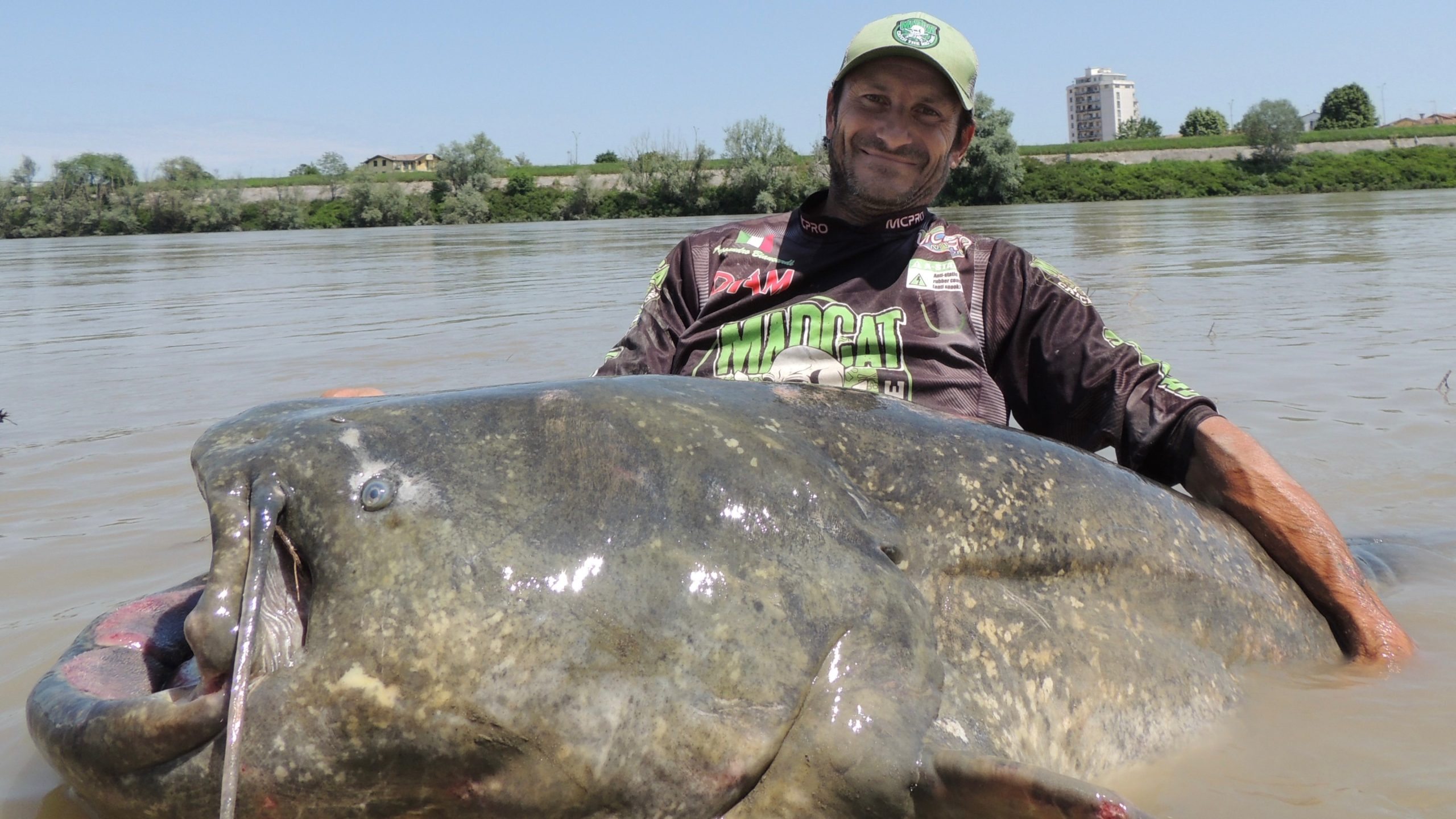
A giant catfish, measuring 2.9 meters in length, is the largest ever caught.
The waters of Italy’s Po River are home to true giants of the freshwater world—European catfish (Silurus glanis). Recently, a local angler caught a specimen that could become a new world-record holder for length.
Italian fisherman Alessandro Biancardi caught a massive catfish measuring 2.85 meters in length in a shallow part of the Po River in the Lombardy region of northern Italy. This exceeds the current world record by 4 centimeters.
According to the fisherman, over more than two decades of catfishing, he has never encountered a fish this large. When his catch first broke the surface, Biancardi realized he was dealing with a true river giant.
After its capture, the fish was carefully measured and released back into the river. All necessary materials and supporting data were submitted to the International Game Fish Association (IGFA), which registers world records.
The European catfish is considered the largest freshwater fish in Europe among species permanently found in rivers and lakes. Originally widespread in Central and Eastern Europe, it has been actively introduced to other regions of the continent in recent decades. Today, large populations are found in Italy, France, and Spain.
The Po River has long been famous for its record-breaking catfish. The previous record was also set here: a 2.81-meter-long catfish was caught in April.
Experts note that in their new habitats, the catfish have found favorable conditions for rapid growth. According to Per Larsson, a professor at Linnaeus University who studies predatory fish, the warm climate, ample food, and suitable environment allow these animals to reach impressive sizes much faster than in northern countries.
Research conducted in Sweden has shown that a catfish approximately 1.95 meters long could be approximately 70 years old. However, the specimen caught in Italy is likely significantly younger—the scientist estimates its age at approximately 20–30 years. It would take the fish about a century to reach similar sizes in cold Swedish waters.
Despite favorable conditions for catfish growth, the Po River ecosystem is facing serious challenges. For the second year in a row, water levels have remained critically low due to reduced snowfall in the Alps, which typically feeds the river in the summer. The drought has already led to several consequences, including the discovery of an unexploded World War II bomb on the banks of the Po.
Scientists are not yet able to accurately assess the impact of the prolonged drought on the European catfish population. However, this invasive species has proven quite successful in its new environment and has practically displaced the native Adriatic sturgeon, whose numbers have sharply declined.
 Discuss
More news
Discuss
More news