The chain stretched over the edge of a coral ledge and disappeared into the darkness that seemed alive. Elias hovered above it in the water, watching the bubbles slowly rise upward. The beam of his flashlight caught only a few links, then a solid black void. It seemed as if he was looking into a bottomless mouth.
His heart was beating so loudly that it drowned out the sound of the ocean. Everything in him was screaming: turn back, climb to the light. But the chain stretched down, motionless and unnaturally long. It did not look lost—more like it had been deliberately placed.
And suddenly something moved below. A barely noticeable vibration passed through the metal, stirring up sand. Elias froze. For the first time in his entire time at sea, he felt tiny, between the light above and the darkness below.
That evening, the sea was calm. The sun painted a golden stripe on the water. Elias was returning to the dock, steering his trawler. He was new to the village—he was tolerated but not accepted.
That day, he had gone further than usual. And just then the ship jerked sharply. A metallic crunch sounded under the hull.
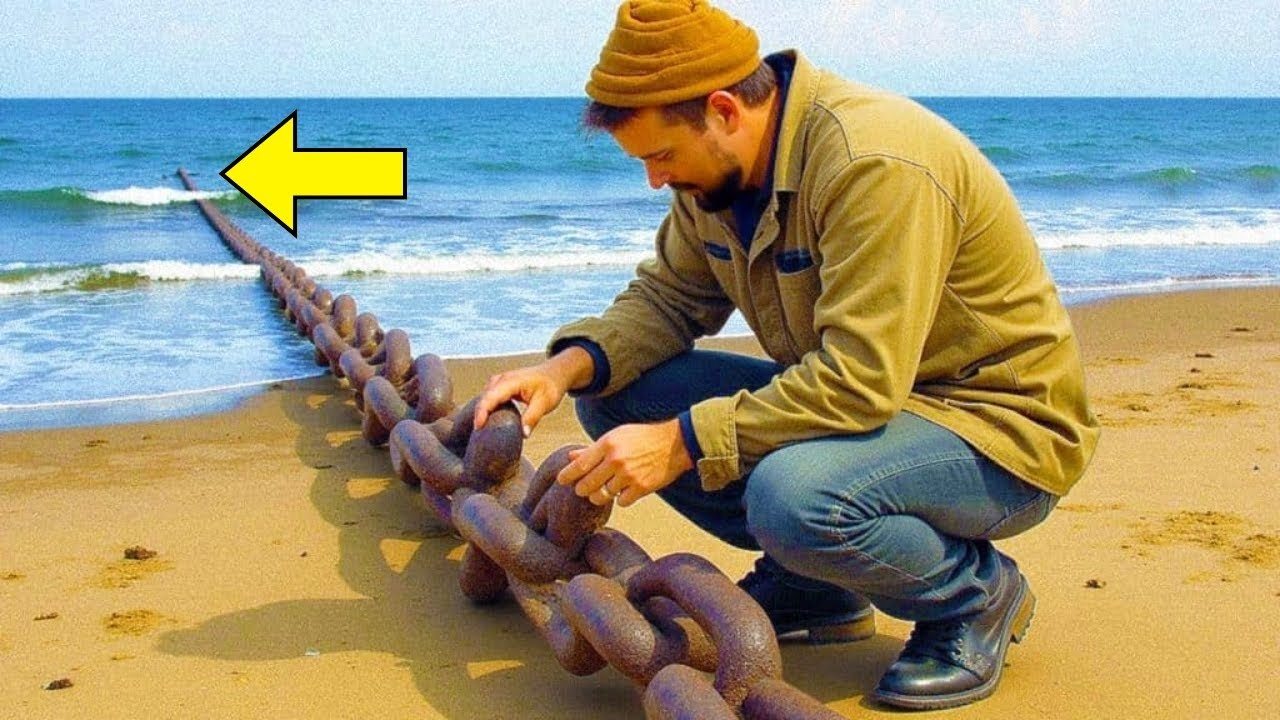
He turned off the engine and leaned over the side. A dark silhouette was visible in the water. It was a chain—huge, rusty, thick as a human arm. It stretched in both directions: out to sea and back to shore.
On land, Elias tried to pull on one of the links. In vain—it was as if the ocean itself was holding it. But curiosity won out. He tugged harder—and the chain moved. The metallic sound was sharp, almost threatening.
Just then, screams were heard.
Three fishermen ran to him.
“Don’t touch it!” one shouted.
The gray-haired man looked at him with anxiety:
“Do you want to cause trouble?”
They said that a few days ago, one of the locals had gone looking for the end of the chain and disappeared. His boat was found empty.
Elias didn’t believe them. But something in their words left a mark.
The next day, he decided to return. Edwin, the son of the missing man, went with him.
They followed the sonar signal. The chain stretched far out into the sea until it led them to a place where the bottom dropped off into a deep abyss.
They dove in.
Underwater, the chain looked even more massive, covered in coral. It led them to the edge of an underwater cliff and then into a dark cave.
Elias wanted to turn back. But Edwin was already swimming forward.
A long, narrow tunnel led them into an underwater cavity with air. There, they found his father, alive but exhausted.
The man had miraculously survived by finding an air pocket.
The air in the cylinders was almost gone. They decided to return, sharing their breath.
As they rose, a shadow followed them—a large, silent one. And their strength was rapidly ebbing away.
And yet they broke through to the surface.
They were met on shore in silence, with tension. But the man had survived.
Later, he explained:
This is neither treasure nor secret. It is an old sea barrier chain, once installed to block the bay’s entrance during the war.
An ordinary piece of history that almost became a trap.
That evening, they sat by the sea, listening to the waves. And for the first time in a long time, the ocean seemed just water—and not something more.
 Discuss
More news
Discuss
More news