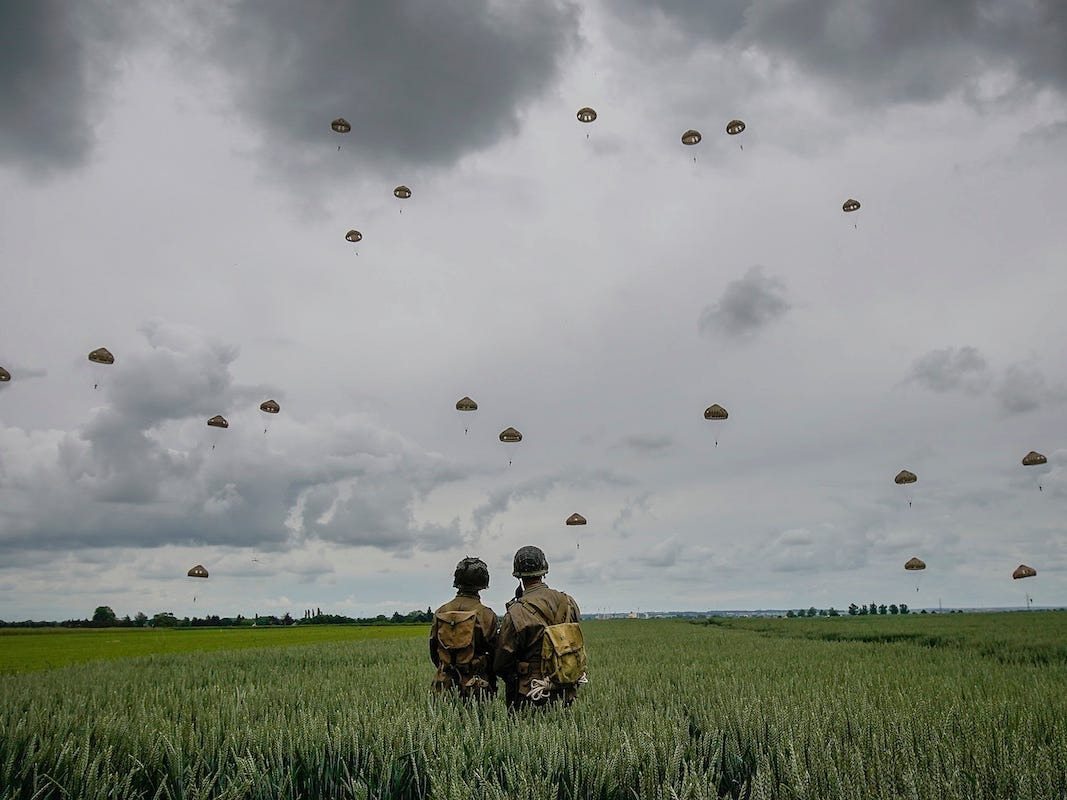
In the hours leading up to the massive Allied invasion of Normandy, military leaders relied not only on troops and weapons, but also on deception. Among the most unusual tactics used during World War II was the deployment of hundreds of fake paratroopers intended to confuse German forces and disrupt their response to the coming assault.
Before dawn on June 6, 1944, aircraft crossed the skies above occupied France and released large numbers of parachutes into the darkness. From the ground, it looked like an enormous airborne invasion was unfolding.
Panic quickly spread through nearby German positions. Troops were rushed toward the suspected drop zones in preparation for combat.
When daylight finally revealed the truth, many soldiers were stunned. Scattered across fields and forests were not real paratroopers, but cleverly designed decoys made from fabric, rubber, straw, and canvas.
The concept of using dummy soldiers had existed before the Normandy invasion, but Allied engineers refined the idea into a far more effective deception tool. British specialists created early models nicknamed “Rupert,” small human-shaped figures weighted with sand or straw so they would descend realistically beneath parachutes.
Later, American versions known as “Oscar” dummies improved on the design. Certain models even produced sounds that imitated gunfire, marching soldiers, or shouted commands.
As D-Day planning intensified, Allied commanders realized the invasion’s success depended heavily on misleading the German military about where attacks would occur. This massive misinformation effort became part of a broader strategy called Operation Bodyguard.
One section of that plan was Operation Titanic, a mission specifically created to simulate large airborne assaults away from the real landing beaches in Normandy.
The operation was divided into several coordinated drops across northern France. Hundreds of dummy paratroopers were released during the night to create the impression that Allied airborne divisions were landing in multiple locations simultaneously.
To strengthen the illusion, real Allied commandos landed alongside the decoys. Teams from the SAS and Special Operations Executive carried explosives, sound equipment, and weapons into the drop zones.
At the same time, Royal Air Force crews flew dangerous low-level missions through enemy anti-aircraft defenses to deploy the fake paratroopers accurately.
The timing of the operation was critical. The dummy drops occurred only hours before Allied troops stormed the beaches of Normandy.
When Operation Titanic began on the night of June 5, Allied aircraft released hundreds of decoys over carefully selected areas of France. In the darkness, the descending figures appeared frighteningly authentic.
German commanders reacted immediately. Reserve units were redirected inland to investigate reports of airborne attacks, pulling valuable troops away from the real battle zones near the Normandy coast.
Although the mission successfully distracted German forces, it came at a cost. Several RAF aircraft were destroyed during the operation, killing members of their crews. Some SAS operatives who parachuted into the fake landing zones were captured shortly afterward, and a number of them were executed despite being uniformed soldiers.
Even so, the deception achieved its objective. By spreading confusion and forcing German commanders to divide their attention, the fake paratroopers helped the Allies gain a critical advantage during the opening hours of D-Day.
What appeared to be a bizarre military trick ultimately became one of the most effective deception operations of World War II — proving that sometimes illusion could be just as powerful as firepower.
 Discuss
More news
Discuss
More news