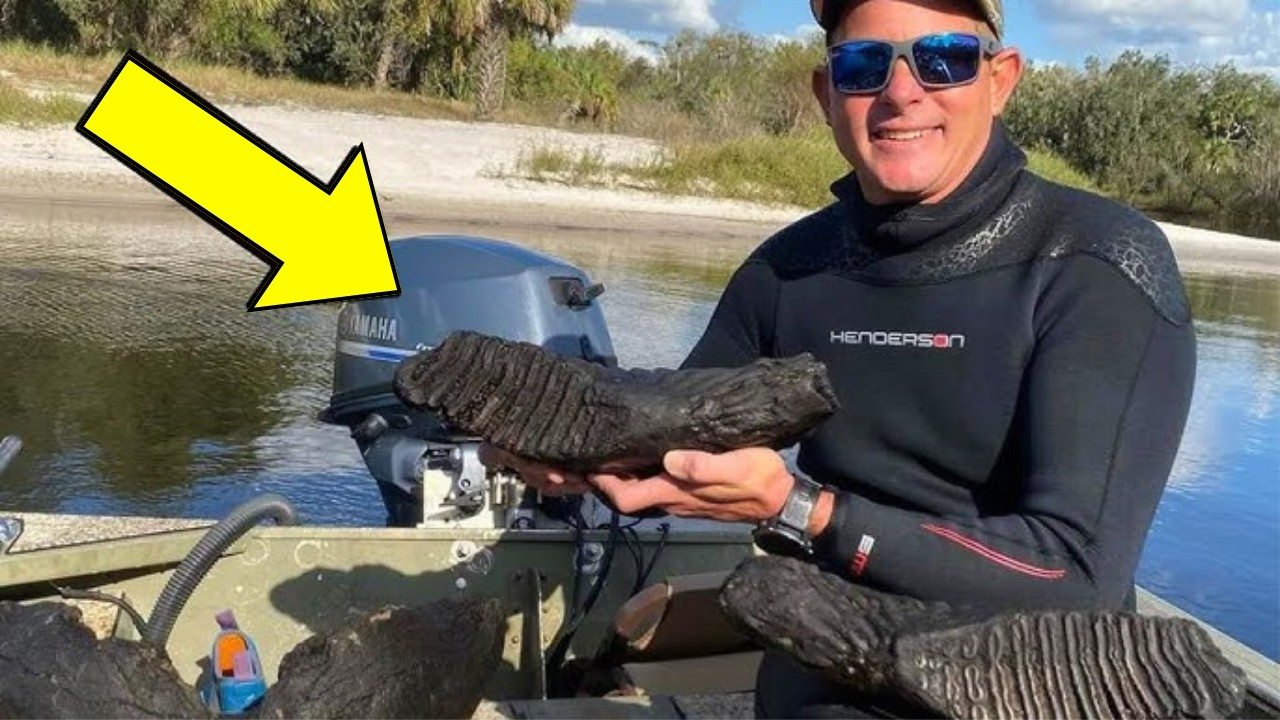
Mike Smith had spent years diving in Florida’s rivers, so he was familiar with the murky water, shifting sand, and even the danger of alligators. But during one dive in a remote section of the river, he noticed something unusual lying partly buried beneath the silt.
At first, Mike thought it was nothing more than an old tree trunk. The object was dark, covered in sediment, and appeared to have been underwater for years. He was ready to move on when he noticed its surface looked strangely smooth in some places and porous in others.
Mike turned back.
Using his hands, he carefully brushed away the sediment. As the cloud of mud slowly disappeared, a pale brown surface emerged. There was no bark, no broken wood, and no branches. Instead, the object had several large cavities running along its side.
Realizing this wasn’t ordinary debris, Mike called his diving partner over. Together, they began removing the sand around the enormous object. The strong current made the task difficult, constantly filling the water with clouds of silt.
Eventually, they managed to expose enough of the find to see its true shape.
The strange holes weren’t signs of rotting wood. They were tooth sockets.
And along the upper edge were enormous fossilized structures resembling prehistoric teeth.
Mike was staring at a gigantic ancient jawbone.
The divers photographed the discovery and contacted fossil experts. The specialists immediately warned them not to clean, scrape, or polish the specimen. Even the sediment surrounding the bone could contain valuable information, and its exact location was important.
After examining the photographs and dental structures, experts reached an astonishing conclusion.
The enormous jaw belonged to a mammoth that had lived during the Ice Age.
The discovery suggested that the riverbed had preserved part of an animal that existed thousands of years before modern Florida, long before today’s roads, cities, and communities.
The massive bone had apparently remained hidden beneath layers of sand and sediment for roughly 10,000 years. A small change in the river’s current had finally exposed a portion of it—and Mike happened to be in exactly the right place to notice.
Had he ignored the strange shape or assumed it was a rotten log, the ancient relic might have remained buried for centuries more.
Instead, Mike chose not to keep the discovery for himself. Rather than selling it as a private collectible, he donated the mammoth jawbone to the Florida Museum of Natural History.
What began as an ordinary dive ended with the discovery of a remarkable fragment of prehistoric Florida—a silent reminder that beneath today’s rivers, the past can sometimes still be waiting to be found.
 Discuss
More news
Discuss
More news