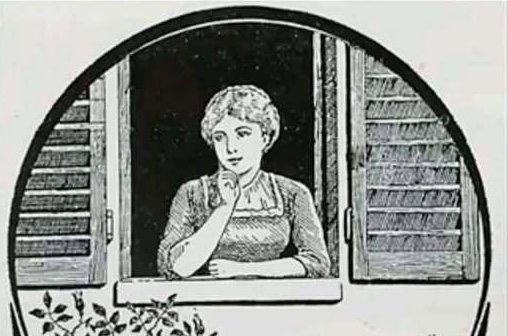
At first glance, this vintage black-and-white illustration seems completely ordinary. A young woman stands by an open window, resting her chin thoughtfully on her hand. Before her lies a dense garden filled with roses, leaves, branches, and countless meticulously drawn details.
Yet, something unexpected is hidden within this tranquil scene.
Somewhere amidst the lines and shadows lies a man’s face. It is positioned so cleverly that most people do not notice it right away.
People usually begin their search in the garden. They examine the roses, the spaces between the leaves, the dark areas, and every suspicious outline. It seems as though the artist has hidden a small figure among the plants.
But that is precisely where the main trap lies.
The man is not necessarily depicted as a distinct character. His face seems to emerge from the details of the picture itself. The window lines, the branches, the flowers, the shadows, and other elements—when viewed from a certain angle—come together to form an entirely new image.
So you shouldn’t look for a small human figure.
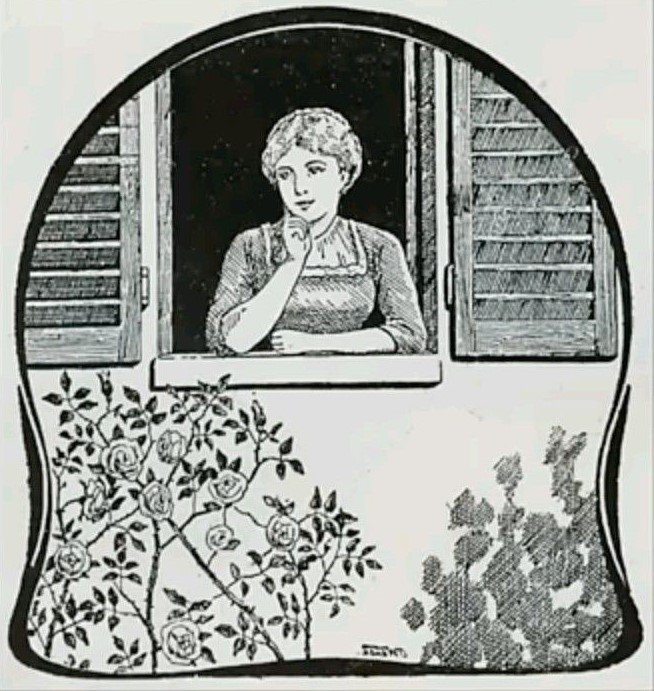
Look for a face formed by the surrounding objects.
Try changing the way you look at the image. Don’t dwell on individual roses or leaves. View the image as a whole; step back a little and squint slightly.
Sometimes, only then does the complex composition begin to coalesce into a unified whole.
Pay attention to large shapes and empty spaces. A dark patch that initially seems like a simple shadow might turn out to be part of an eye. The curve of a leaf could transform into a nose, while the line of a window or a plant might become the outline of a head.
From the very first moment, our brain tries to make sense of what is before our eyes. It quickly identifies familiar objects: the young woman, the window, the garden, the flowers. Everything else is then automatically perceived as background.
And that is precisely why the hidden face can remain unnoticed.
To get closer to the solution, try asking yourself a different question. Instead of asking, “Where is the man hiding?”, ask:
“Which elements of this picture can come together to form a face?”
Don’t be surprised if you don’t spot it right away. Optical illusions work precisely because the brain struggles to let go of its initial interpretation of what it sees.
But then, a remarkable moment occurs.
You keep looking…
And suddenly, you notice him.
Once you do, the hidden face becomes so obvious that it’s almost impossible to “unsee” it.
Puzzles like this are sometimes billed as intelligence tests, or even linked to “brain youthfulness.” However, this kind of image doesn’t qualify as a scientific test.
What it *does* demonstrate beautifully is that our perception relies heavily on attention, expectations, and exactly where our eyes are focused.
So, before looking for the answer, try viewing the illustration again.
Don’t just focus on the young woman.
Don’t look for a tiny figure among the roses.
Step back from the screen.
Squint a little.
Take in the whole picture at once.
And remember the key secret to this puzzle:
The man might not be hidden *inside* the image—the picture itself can transform into his face.
Nothing in the drawing changes.
Only your perspective shifts.
So, have you seen him yet?
 Discuss
More news
Discuss
More news