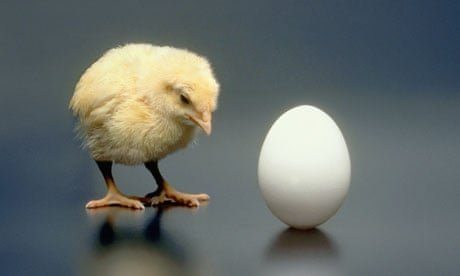
The chicken-or-egg question is one humanity has debated for centuries. At first glance, the answer seems impossible: a chicken comes from an egg, yet a chicken must lay the egg. However, evolutionary biology allows us to break this circular logic.
The scientific answer is simple: the egg came before the chicken.
Ancient philosophers also tried to unravel this riddle. Aristotle, for instance, viewed it as a paradox, since any explanation inevitably led back to the starting point. Modern science suggests looking at the issue not from the perspective of an individual chicken, but through the lens of millions of years of evolution.
Eggs existed long before birds.
Egg-laying animals appeared on Earth long before modern birds. The first organisms that reproduced via eggs existed hundreds of millions of years ago.
Reptiles, ancient fish, and dinosaurs laid eggs long before the first birds emerged. Therefore, the egg itself is not an invention of the chicken; it is a far older method of offspring development.
So, where did the first chicken come from?
The modern domestic chicken (*Gallus gallus domesticus*) emerged through a long process of evolution and domestication. Its closest wild relative is the red junglefowl, found in Southeast Asia.
No single day marked the birth of the first chicken. Birds changed gradually from generation to generation until their descendants acquired the characteristics that allow us to classify them as domestic chickens today.
At some point, two birds—not yet fully modern chickens—laid an egg. Thanks to natural genetic variation, the embryo inside it possessed a combination of traits characteristic of the very first true chicken.
This results in a distinct evolutionary transition: **the egg appeared first, and the first chicken subsequently hatched from it**.
But which egg counts as the first?
An interesting point arises here. If we are talking about eggs in general, the answer becomes even more obvious. Eggs existed hundreds of millions of years before chickens—and even before the first birds appeared.
If we speak specifically of a chicken egg, evolutionary logic leads to the same conclusion: an egg containing the genetic traits of the first modern chicken must have appeared before the bird itself.
Thus, the ancient riddle has a perfectly scientific explanation. The egg came first not because a modern chicken laid it, but because eggs—as a method of reproduction—emerged long before chickens did.
Evolution transforms what once seemed like an insoluble philosophical paradox into a story of gradual change spanning hundreds of millions of years.
 Discuss
More news
Discuss
More news