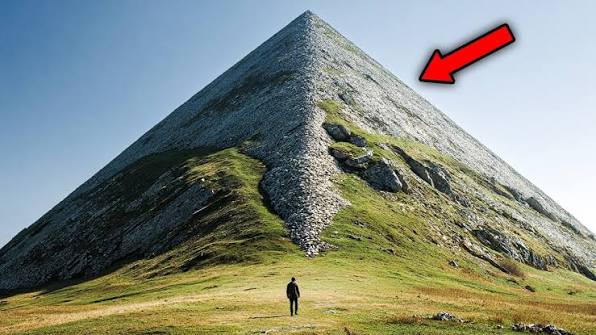
For thousands of years, people believed the most famous ancient pyramids were located in Egypt, Central America, and Peru. But in a small Bosnian valley near the town of Visoko, something was discovered that led alternative-history enthusiasts to question the conventional understanding of the past.
From the ground, Mount Visočica looks quite ordinary: dense forest covers its slopes, and its summit is indistinguishable from the surrounding hills. However, in satellite imagery, its contours take on a strikingly geometric appearance. Four nearly uniform sides, a truncated top, and an orientation aligned with the cardinal directions—these features caught the attention of researchers.
In 2005, Bosnian researcher Semir Osmanagić put forward a sensational hypothesis: this was not an ordinary mountain, but a massive “Pyramid of the Sun.” He claimed it stands over 220 meters tall and is part of a complex of five pyramids arranged in a specific geometric pattern.
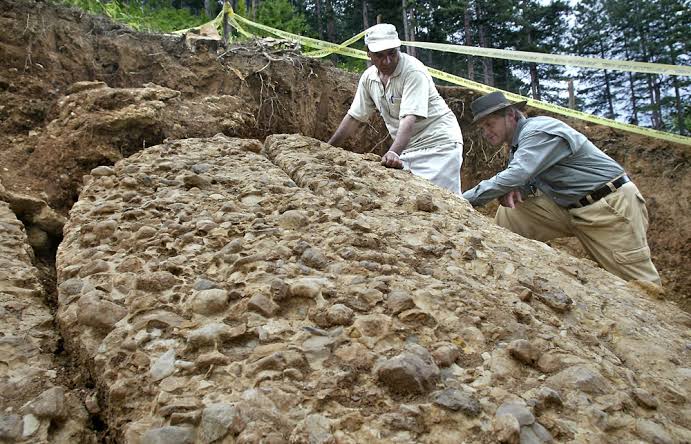
Subsequent excavations further fueled interest in the mystery. Researchers reported discovering large, rectangular stone slabs, which they interpreted as artificial construction material. Even more questions were raised by the Ravne underground passages—an extensive network of tunnels extending beneath the site of the alleged complex.
Proponents of the theory claimed that unusual stone structures, a stable microclimate, and electromagnetic signals had been detected inside. According to the research team, some samples of organic material recovered from the tunnels were dated to approximately 30,000 years ago. If these findings were confirmed and truly indicated ancient human activity, it could fundamentally alter our understanding of prehistoric Europe.
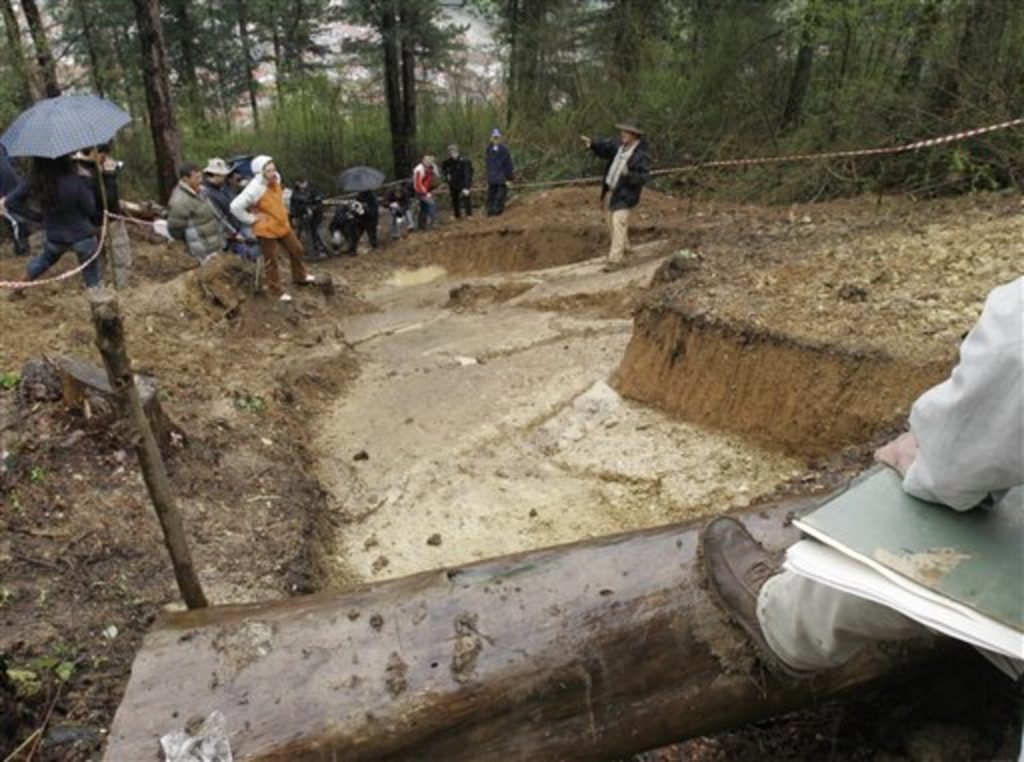
The scientific community, however, met these claims with extreme skepticism. Geologists attribute the unusual shape of Visočica to natural weathering processes and the tectonic characteristics of the rock formations. To date, no compelling archaeological evidence has been presented to support the existence of an ancient artificial city or a civilization that built pyramids here.
Despite the controversy, Visoko continues to attract tourists, researchers, and proponents of alternative hypotheses. Some arrive in search of traces of an unknown culture, while others come to behold the unique natural landscape.
So, what lies beneath these Bosnian hills—a grand geological illusion, or a mystery from the past that humanity has yet to unravel?
 Discuss
More news