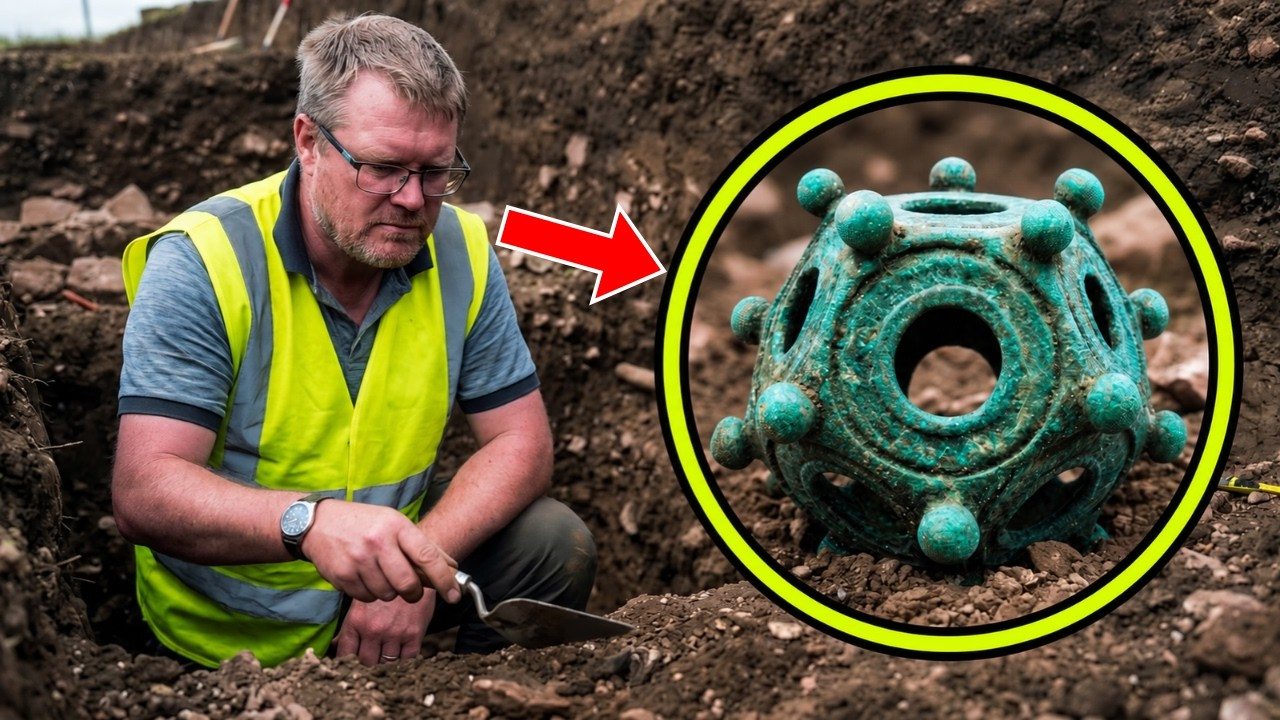
Routine archaeological excavations in a farmer’s field near the English village of Norton Disney were nearing their end. For several days, a team of volunteers and professional researchers examined ancient soil layers, unearthing pottery shards, animal bones, and fragments of roof tiles. It seemed unlikely they would find anything else of note—but in the final hours of the dig, a shovel suddenly struck metal.
Carefully clearing away the earth, volunteer Richard Watts revealed a strange object, roughly the size of a grapefruit. It was a hollow, copper-alloy artifact with twelve pentagonal faces, each with a circular hole of a specific diameter, and small knobs at the corners. Most remarkably, the object remained in near-perfect condition despite spending nearly 1,700 years underground.
Archaeologist Rob Evershed immediately recognized the mysterious structure: a Roman dodecahedron. The first such items were documented as early as 1739. Since then, around 130 examples have been discovered across the former Roman Empire—with the one found at Norton Disney becoming only the 33rd known dodecahedron to be unearthed in Britain.

Yet, the central mystery remains unsolved: why did the Romans create these unusual objects? No surviving ancient text, image, or military document explains their purpose.
In this instance, the researchers were fortunate: the artifact was discovered within an undisturbed archaeological layer, rather than being unearthed by casual treasure hunters. Further excavation revealed that the site also contained 3rd-century Roman coins, pottery, and construction debris. The object itself lay in a pit—originally used for sand extraction and later turned into a dumping ground for refuse.
Scholars have proposed several theories. The dodecahedron may have served as a measuring instrument or an aid for calculating distances. Others suggest it may have been used for knitting wool garments or crafting gloves. Another hypothesis points to a religious function—perhaps its use in rituals or for astrological divination.
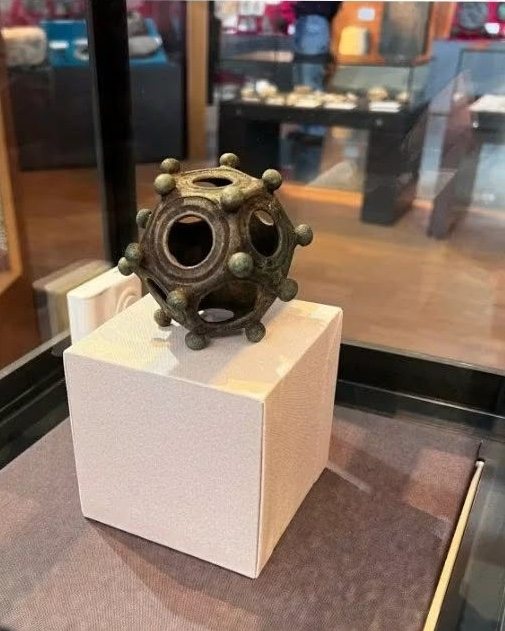
However, none of these hypotheses have yet been convincingly substantiated. The artifact shows no signs of heavy wear, lacks the markings needed for measurement, and shows no evidence of ritual use.
Further research has revealed that this site was once a sophisticated Roman industrial hub, complete with kilns, workshops, and opulent villas. Yet, it remains a mystery why such a valuable metal object ended up discarded among ordinary construction debris.
Nearly 1,700 years ago, a Roman craftsman created a true engineering masterpiece. To his contemporaries, its purpose was likely clear. Today, the dodecahedron sits behind museum glass, its appearance still pristine—yet the central mystery of its history remains unsolved.
 Discuss
More news