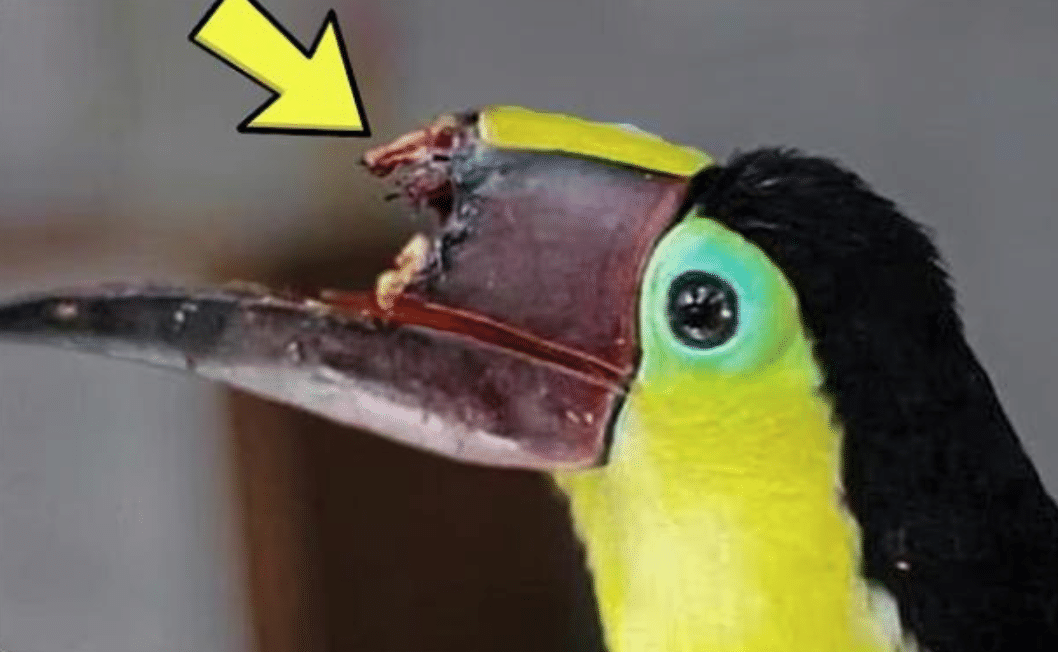
In the lush rainforests of Costa Rica, a heartbreaking discovery changed the fate of one small toucan forever. The bird, later named Grecia, was found with a devastating injury: most of her upper beak had been brutally removed by an unknown attacker. For a toucan, this is far more than a physical injury. Its beak is essential for feeding, regulating body temperature, and surviving in nature. Without it, Grecia had almost no chance of living independently.
She was immediately taken to Zoo Ave, a wildlife rescue center near Costa Rica’s capital. Veterinarians worked tirelessly to save her life, successfully treating the terrible wound. But once Grecia recovered, a much bigger challenge emerged: she could no longer grab food or feed herself properly.
Her future seemed uncertain until an unusual partnership between veterinarians, scientists and engineers offered a solution that sounded like science fiction.
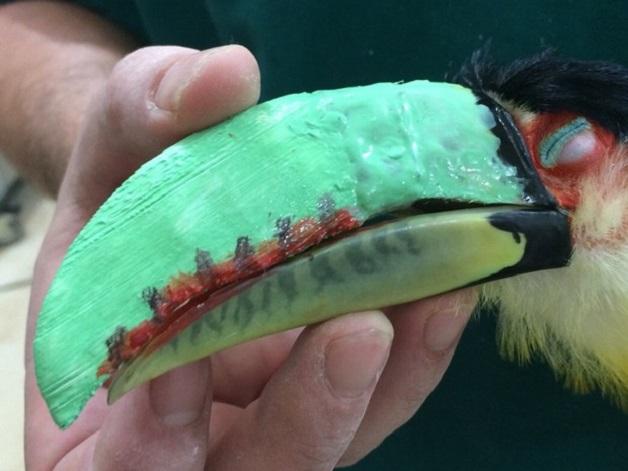
Using 3D-printing technology, specialists created a custom prosthetic beak made from durable nylon. The replacement consisted of two carefully designed components. One was permanently attached to the remaining part of Grecia’s original beak using epoxy, while the second was secured with a special pin. This clever construction allowed rescuers to remove the main section whenever cleaning or maintenance was needed.
The results were extraordinary. With her artificial beak in place, Grecia could once again pick up food and eat without constant human assistance. Instead of spending the rest of her life helpless, she received an opportunity to live comfortably at the sanctuary.
Grecia’s story became a powerful example of how modern technology can transform animal rescue. And she wasn’t the only animal to benefit from such innovation.
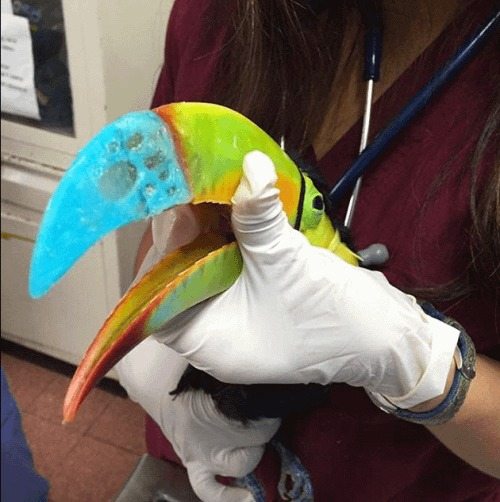
Beauty, a bald eagle whose beak was destroyed by a gunshot, received a specially designed prosthetic replacement. Fred, a red-footed tortoise, had his badly damaged shell reconstructed with the help of 3D printing. Winter the dolphin learned to swim again with a specially developed artificial tail, while Mosha, an elephant injured by a landmine, received a series of prosthetic legs.
These remarkable cases prove that technology isn’t just changing human lives. Sometimes, a carefully designed artificial body part can mean the difference between death and a second chance at life.
 Discuss
More news