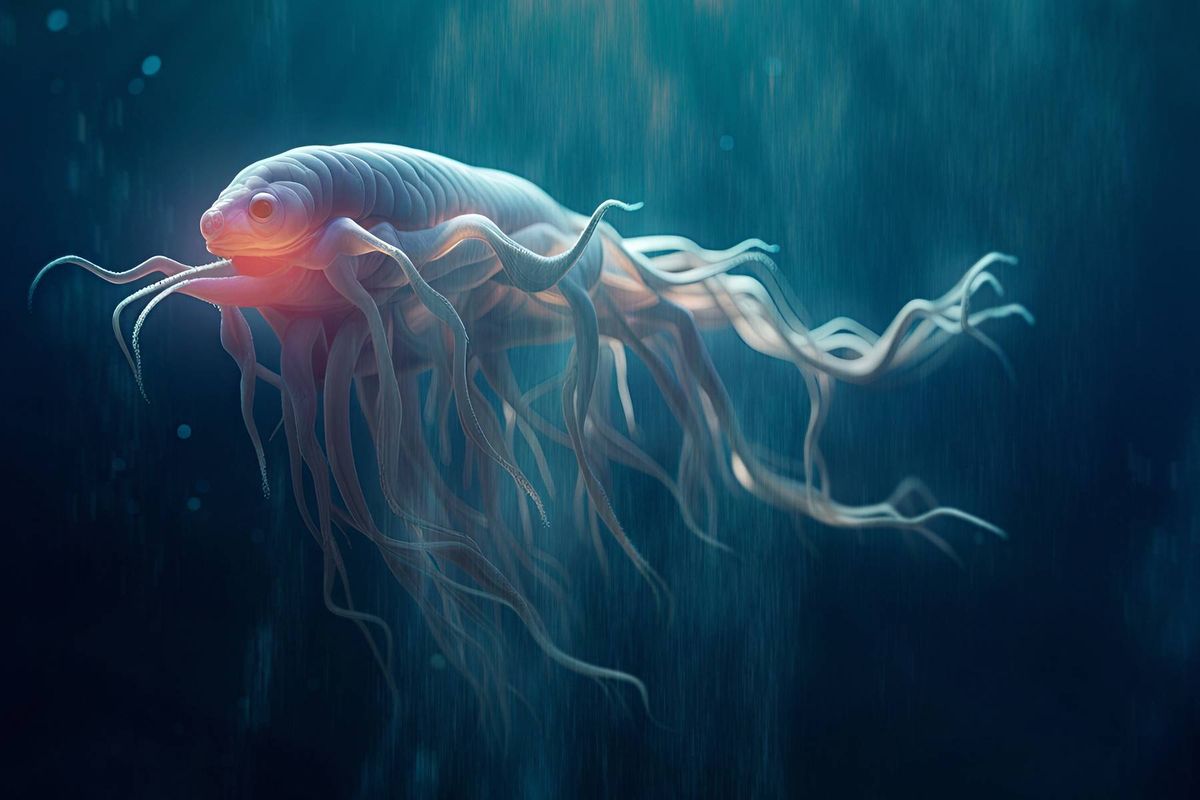
It looks so unusual that researchers are still unsure what group of animals it belongs to. The enigmatic organism was captured on film during a large-scale expedition to the deep-sea trenches off the coast of Japan.
The scientists explored three ocean trenches and lowered equipment to depths of 9,775 meters. During the expedition, cameras recorded over 460 hours of video footage. The footage revealed numerous unusual creatures, but one in particular stood out.
A Creature That Stumped Scientists
At depths between 8,022 and 9,131 meters, researchers spotted a small, pale animal with unusual lobe-shaped appendages. It appeared on camera only twice: once in the Japan Trench and again in the Izu-Ogasawara Trench. At first, experts assumed they were looking at a member of the opisthobranch mollusks. However, subsequent examination of the video footage revealed that this explanation did not explain the organism’s features.
As a result, scientists were faced with an unusual problem: the creature could not yet be confidently classified even within a known phylum. In other words, its precise place in modern biological classification remains a mystery.
The ocean floor is teeming with life.
The unusual organism was far from the expedition’s only surprise. The researchers recorded representatives of 108 different animal groups.
Among them were predatory sponges, giant isopods, and other creatures adapted to life under enormous pressure and in complete darkness.
The giant amphipods attracted particular attention. Some of them were larger than fish living at the same depth. The cameras also captured an octopus several kilometers below the ocean surface. A vast territory remains a mystery.
The results of the study were published in the scientific journal Biodiversity Data Journal. The scientists emphasize that the deepest ocean trenches remain some of the least explored places on the planet.
Every new dive reveals how diverse life can be in places where humans cannot exist without specialized equipment. Extreme pressure, virtually no light, and harsh conditions do not necessarily mean the absence of life.
And the mysterious pale creature remains a true biological puzzle. Perhaps further study of such records will help us understand what kind of organism the researchers encountered—or confirm that they are indeed a representative of an extremely rare and as yet unknown group.
 Discuss
More news
Discuss
More news