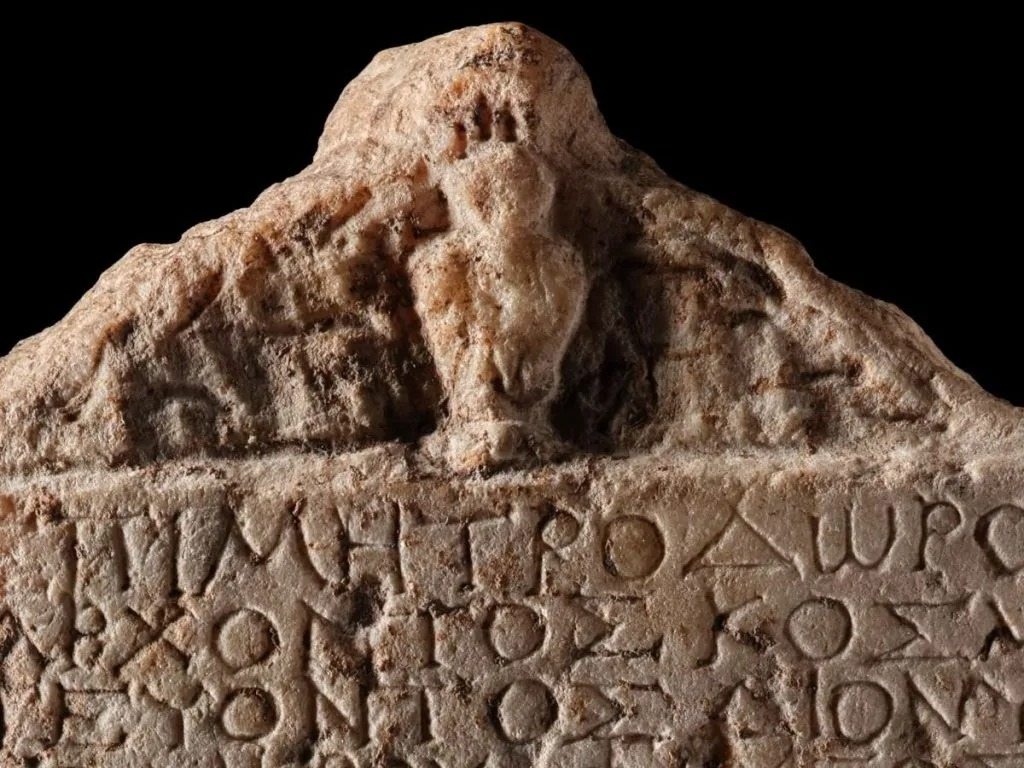
Archaeologists excavating in the Dutch city of Heerlen made an unusual discovery: a lead tablet, approximately 1,900 years old, on which an unknown person pleaded with higher powers to punish his enemies. The artifact was found beneath the town hall square, the site of the Roman military settlement of Coriovallum.
What makes this find unique is that the text was engraved not in Latin, as is typically found on such objects, but in ancient Greek.
Residents of ancient Rome often appealed to supernatural powers when faced with personal conflicts. This could include lawsuits, love rivals, financial disputes, or the desire to harm an adversary. For this purpose, special lead curse tablets, known as defixiones in Latin or katadesmoi in Greek, were created.
Over the centuries, the inscriptions have been severely worn away, so specialists from the Institute of Papyrology at Heidelberg University used modern technology called Reflectance Transformation Imaging (RTI). This method combines multiple photographs of an object taken under different lighting conditions, allowing for the finest surface details to be revealed.
After processing the images, the researchers identified three distinct blocks of text.
Analysis revealed that one section contains invocations to deities and supernatural beings, written in the traditions of ancient Egyptian magic. The entire text is written in ancient Greek, making this find extremely rare for the northern regions of the former Roman Empire, where such tablets were almost always composed in Latin.
In addition to the text, the scientists discovered three special magical symbols—the so-called characters. These were believed to help convey the content of the spell to the powers the author invoked. Below were the carved names of four people—two men and two women. All are referred to as “comrades in slavery.” Interestingly, the men’s names are of Latin origin, while the women’s are Greek.
It is impossible to determine the exact content of the spell, but experts note that such texts were most often created against love rivals, legal opponents, competitors, or athletes.
Heerlen has long been considered one of the most important Roman-era archaeological sites in the territory of today’s Netherlands. Previous discoveries here included the burial of a Roman soldier named Flaccus, an ancient limestone gaming board, and other artifacts revealing the lives of residents of the empire’s border provinces.
Nevertheless, the new find stands out even among the many known curse tablets. Similar objects have been discovered in Greece, France, and other European countries, but the combination of ancient Greek and Egyptian magical formulas and symbols is extremely rare.
According to scientists, the artifact clearly demonstrates how closely the religious and magical traditions of various Mediterranean peoples were intertwined in the first centuries AD.
 Discuss
More news
Discuss
More news