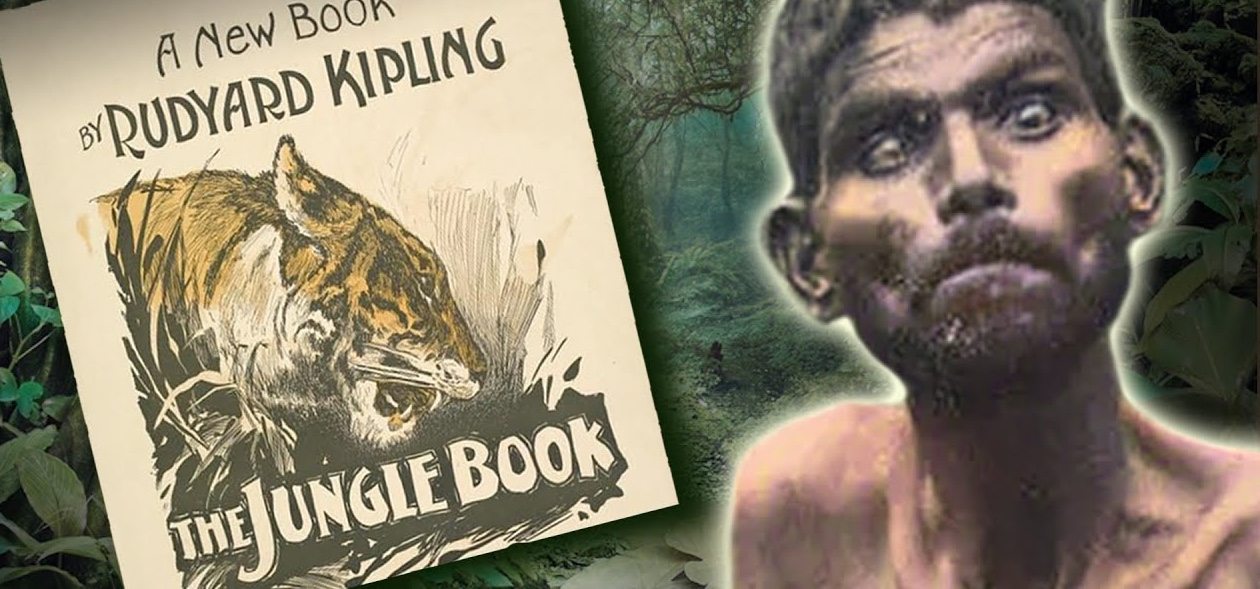
The story of Mowgli from Rudyard Kipling’s famous book is known worldwide. However, in real life, there was a man whose fate was far more tragic.
This man was Dina Sanichar, an Indian whom many consider to be the prototype for Mowgli.
In February 1867, a group of hunters was exploring the forests of the Bulandshahr region in northern India. Near a cave, they spotted wolves and prepared to hunt. However, they soon discovered a small boy, approximately six years old, among the animals.
The child did not respond to questions, did not speak, and behaved just like the wolves around him. The hunters decided not to abandon him in the forest and instead took him to the Sikandra Missionary Orphanage near Agra.
Since his real name could not be established, they gave him a new name: Dina Sanichar.
The orphanage staff quickly realized that the boy was very different from the other children. He moved primarily on all fours, had great difficulty maintaining balance on two legs, and preferred raw meat to any other food.
Before eating anything, Dina would always sniff the food.
The most challenging task for the caregivers was communicating with the boy. Instead of speaking, he growled, howled, and made wolf-like sounds.
Even simple gestures were ineffective in establishing contact.
Over time, Dina began to understand some of the caregivers’ comments, but he never learned to speak on his own. Experts believe that the early absence of human speech during a critical period of development virtually deprived him of the opportunity to fully master language.
Gradually, he began to walk upright more often, became accustomed to wearing clothes, and observed basic household rules.
According to contemporaries, over time, he even adopted one of the habits of adults of the time—smoking cigarettes.
Despite these changes, he was never fully able to adapt to life in society. Most of her instincts and behavioral characteristics remained with her until the end of her life.
Dina Sanichar’s story is not the only such case.
Oksana Malaya, a Ukrainian woman, gained widespread fame. Her parents abandoned her as a young child, and she lived among stray dogs for several years. After being rescued, she spoke poorly, crawled on all fours, and imitated the animals’ behavior. Through years of rehabilitation, she learned to speak and adapted to life.
Another famous example is the Indian boy Shamdeo, found in the forest with wolves. Eyewitnesses described him as having overgrown fingernails, rough calluses on his hands and feet, and unusually sharp teeth. Like Sanichar, he did not live long.
Dina Sanichar died in 1895, at about 35 years old. The cause of death was tuberculosis, a disease that was often fatal in the 19th century. Although he spent most of his life among humans, he never fully integrated into human society. He remained forever a man caught between two worlds—nature and civilization.
 Discuss
More news
Discuss
More news